
The Right to Remember: Comparative Perspectives on Truth-Telling and Colonial Silence in Bharat, Canada, and Australia.
When former colonisers tell the truth about their crimes, the world calls it healing and courage. When Indians remember colonial violence and erasure, we’re told to move on. This essay asks who gets to remember—and why that double standard exists.
When I hear Canadians speak publicly about children torn from their families or watch Australians stand in Parliament and say, “We were wrong,” the language used for these acts is gentle. It is called healing, reconciliation, courage. When Indians speak about deindustrialisation, looted economies, engineered famines, or the systematic shaming and erasure of our civilisation, we are much more likely to be told to move on. The contrast sits uneasily in my chest. It is as if former colonisers are allowed the dignity of remorse, while the colonised are denied the dignity of remembrance.
This difference is not a minor rhetorical quirk. It shapes how we see ourselves, how we teach our children, and what futures we can even imagine. If Canada and Australia can institutionalise truth‑telling about their darkest histories, why is Bharat expected to maintain a polite silence about its multiple colonisations and, pertinently, two centuries of extraction and humiliation? Who authorised this double standard of memory, and why have we complied with it for so long?
I am writing this now because I do not believe our only choices are outrage or forgetfulness. There is another path. It is slower and less glamorous than viral clapbacks. It is the path of truth‑telling, which I see as a civilisational duty. The question beneath everything else is simple: who gets permission to reopen the past, and who is shamed for even trying?
The Double Standard of Memory
When former colonisers establish commissions, gather testimonies, and rewrite official narratives about their own crimes, the world applauds. Canada’s Truth and Reconciliation Commission (TRC) becomes a model of moral courage. Australia’s Bringing Them Home report and National Apology are framed as necessary steps towards national healing. The language is generous. These societies are seen as “facing their history” and “taking responsibility.”
Yet when Indians talk about colonial violence, the drain of wealth, or the deliberate erasure of our knowledge systems, the reaction is often embarrassment and irritation. We are accused of dwelling, wallowing, refusing to be “positive.” The same act of remembering is called healing in one context and victimhood in another. Both are talking about the past. Both are talking about harm. Yet only one side is routinely shamed for remembering it.
That difference should bother us. It tells us that memory itself has been colonised. Some memories are allowed to be public, institutional, solemn. Other memories are tolerated only as private wounds, to be handled quietly, lest they disturb the global story of progress and modernity.
The Vocabulary of Dismissal
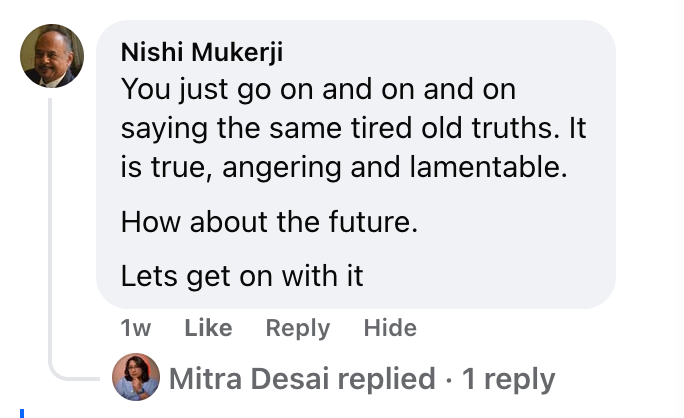
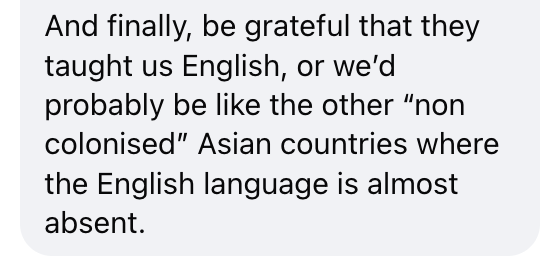
If you have ever tried to speak about our history, you have probably heard the stock phrases that come back at you like a reflex. Sample some comments on my posts below:

“Yeh sab pata hai. Kya kare ab?”
“Rone dhone se kya faayda?”
“Past ko chhod do, aage badho.”
On the surface, these lines sound practical and forward‑looking. Quite simply, many of us are tired of analysis that never seems to translate into anything. But these phrases do something far more dangerous. They function as a socially acceptable way to shut down uncomfortable questions. They mask a refusal to engage with the root causes of our current struggles. They suggest that to ask “How did we get here?” is a luxury at best and a threat at worst. In doing so, they protect not only our mental comfort, but also the narratives that were built to keep us small.
Who Is Telling Us to Move On?
When I look at the chorus of “move on” voices, I see two distinct groups.
The first are the colonial apologists.
These are often people from former imperial countries, or their admirers, who feel personally attacked when the “civilising mission” is questioned. For them, the empire’s story is one of progress, railways, law, and order. Any mention of stolen land, wealth, appropriated knowledge, or brutal repression sounds like an accusation. They need us to move on because our memory threatens their pride. For them, our silence is a convenient shield.
The second are the tired Indians.
These are not people defending the empire. They are people who are exhausted. They live with the realities of corruption, inequality, unstable jobs, and fraying institutions. They pride themselves on survival. “We built ourselves up, do not cry now,” is the underlying sentiment. They believe that constantly invoking the past weakens us, that dignity lies in refusing to play victim.
The tragedy is that this posture, which looks like resilience, often conceals something else: unseen trauma. We were never given a full vocabulary for what was done to us. Terms like “cultural genocide” were taught to us in the context of others, never ourselves. We were trained to be embarrassed by our own knowledge systems and grateful for the very process that undermined them. In such a world, it feels noble to stay silent. In reality, it is a learned inability to name our wounds.
Truth‑Telling Is a Mechanism, Not a Mood
This is why I insist on using the term truth‑telling rather than simply “talking about history.” In transitional justice work, truth‑telling is not a mood or a sentimental activity. It is a structured process, with a specific purpose and architecture.
Truth‑telling, in this sense, does four things:
- It exposes truths that were denied, distorted, or silenced. It brings forward evidence that contradicts official myths.
- It centres those who suffered, not the institutions that harmed them. Survivors, not bureaucrats, become the primary narrators.
- It names the policies and actors responsible. It traces lines from decision to consequence and refuses vague talk of “tragedy,” as if no one made choices.
- It builds a public record so that future generations cannot be told, “It was not so bad,” or “You are exaggerating.” It anchors memory in documented fact.
In plain language, truth‑telling is how a society stops lying to itself. It is not intended to replace reparations or reforms, but to make them meaningful. Without truth‑telling, apologies risk becoming public relations, and compensation risks becoming hush money.
The Trap and the Map
There is a world of difference between wallowing and truth‑telling. The two often get conflated, which is why so many people recoil when the past is mentioned.
Wallowing means repeating “they hurt us” without context or direction. It keeps us stuck in a loop, where pain becomes identity and grievance substitutes for strategy. Wallowing traps us. It feeds victimhood.
Truth‑telling, by contrast, is a mapping exercise. It documents how specific policies and narratives produced specific harms: economic impoverishment, broken institutions, psychological inferiority, cultural fragmentation. It then traces how those harms continue to shape our lives in the present. Done well, it transforms pain into clarity. It does not say, “We are broken, so we cannot act.” It says, “Now that we know what happened, we can choose differently.” Truth‑telling is the map that helps us move through and beyond the wound.
The problem is not that we talk about pain. The problem is when we talk about it without structure, without detail, and without purpose. That is why I argue for better truth‑telling, not silence.
Canada: From “Long Ago” to Cultural Genocide
Canada’s path illustrates how a society can move from denial to a more honest record. For decades, non‑Indigenous Canadians responded to complaints about the Indian residential school system much the way many Indians respond to colonial history: “It was long ago,” “Why open old wounds?”
Children had been taken from their families, punished for speaking their languages, and subjected to abuse, all under the banner of “civilisation.”
In 2008, as part of the Indian Residential Schools Settlement Agreement, Canada established the Truth and Reconciliation Commission. Over several years, the TRC travelled across the country, held events, and collected thousands of survivor testimonies. It examined government and church records to build a comprehensive picture of the system’s design and impact.
In 2015, the TRC released its Final Report and an executive summary titled Honouring the Truth, Reconciling for the Future. It concluded that the residential school system amounted to cultural genocide. This was not a casual accusation; it was tied to evidence and international legal discussions about the destruction of a people’s culture and identity.
The TRC also issued 94 Calls to Action. These were not vague hopes. They were specific recommendations addressing education, child welfare, language revitalisation, health, justice, commemoration, and reconciliation. They demanded curriculum changes, funding for Indigenous languages, national days of remembrance, and reforms in how institutions interact with Indigenous communities.
Canada has by no means completed this work. Implementation has been uneven. Yet the existence of an official record and a concrete to‑do list has altered the moral landscape. It is now much harder to say “it was not that bad” without contradicting your own state’s documentation.
Australia: The State Says “We Were Wrong”
Australia’s path has its own rhythm, but a similar logic. Throughout the twentieth century, Australian governments removed Aboriginal and Torres Strait Islander children from their families, creating what is now known as the Stolen Generations. These removals were justified as being for the children’s own good, but the reality was cultural destruction and deep personal grief.
In 1995, the Human Rights and Equal Opportunity Commission launched the National Inquiry into the Separation of Aboriginal and Torres Strait Islander Children from Their Families. Over two years, it collected oral testimonies, archival records, and expert analysis. The result was the 1997 Bringing Them Home report.
Bringing Them Home documented the scale of removals, named the policies that enabled them, and described the profound impacts on individuals, families, and communities. It made 54 recommendations, including official apologies, financial reparations, access to personal records, and reforms to child welfare laws.
More than a decade later, in 2008, the Australian Parliament delivered a National Apology to the Stolen Generations. Then Prime Minister Kevin Rudd acknowledged that the policies were wrong and had caused profound suffering. The apology did not fix everything. But it mattered because the state finally said, “We were wrong,” on the public record.
The story did not end there. In 2021, Victoria established the Yoorrook Justice Commission, the first Indigenous‑led truth‑telling body in Australia with Royal Commission powers. Yoorrook’s mandate is to document historic and ongoing injustices experienced by First Peoples in relation to land, child protection, the criminal justice system, health, and housing. Its work is explicitly linked to the process of negotiating treaties and structural reforms, with final reports and recommendations tabled in 2025.
The Global Standard of Healing
Taken together, Canada and Australia show that what we call healing is not an abstract feeling. It has a structure:
- Gather evidence and create official reports.
- Make concrete recommendations and timelines.
- Publicly admit wrongdoing at the highest levels of state.
Healing, in this frame, is not a mood. It is the result of intentional work. When we look at Bharat through this lens, the absence is stark.
India’s Missing Chapter
In 1947, Bharat accomplished something monumental. We ended formal colonial rule and began the difficult experiment of democratic self‑governance. These are achievements we should never diminish.
But we skipped the truth‑telling.
We did not establish a commission to gather testimonies about the colonial famines, land seizures, or the deliberate destruction of local industries. We did not produce a comprehensive, state‑backed report tracing how imperial policies re‑engineered our economies, our social fabric, and our self‑perception. No equivalent of a TRC was tasked with documenting the drain of wealth, the criminalisation of communities, or the closure of indigenous institutions.
Because of this, we live with what I call a double distortion.
On one side, colonial apologists enjoy great confidence. They can say, “The British gave you railways and the rule of law,” with little fear of being contradicted by an official national record. The harmful aspects of empire remain scattered across academic works and activist accounts, but they have not been woven into a document that the state itself owns.
On the other side, ordinary Indians live with confusion. They experience fractured institutions, deep economic inequalities, linguistic and cultural inferiority complexes, but they are rarely shown a clear map of how these patterns were produced. They do not know where the fault lines came from, so they either blame themselves or each other.
It is difficult to process trauma you were never allowed to name.
Reclaiming the Details of Our Pain
This is why I insist that when we speak of colonial harm, we are not asking to be cast as helpless victims forever. We are asking for precision.
We need to understand how policy decisions in London translated into famine in Bengal. Which export rules, pricing structures, and procurement policies turned local shortages into mass starvation? How did the logic of empire make Indian lives disposable during crises?
We need to understand how the destruction of weavers in places like Dhaka was not an unfortunate by‑product, but part of a deliberate strategy to protect British textile mills. Which tariffs, bans, and coercive practices made handloom unviable? How did violence enforce these economic choices?
The point is not to itemise suffering for its own sake. The point is to look at the wound properly, with enough detail that we can stop blaming ourselves for scars we did not inflict. Only then can we decide, as agents rather than as amnesiacs, what kind of economy and culture we want to rebuild.
Dignity Lies in Remembering, Not Forgetting
We have inherited a story that glorified the coloniser and minimised our ancestors. We were taught that dignity lies in gracious silence, in being good sports about our own dispossession. Questioning this story is often treated as impolite, backward, or “ungrateful.”
I believe this is false.
Dignity does not lie in forgetting. Dignity lies in refusing to participate in our own erasure. Truth‑telling will always feel uncomfortable at first, especially for those of us who were trained to equate maturity with detachment. But discomfort is not the problem. Denial is.
To look back is not to go back. We are not advocating a return to some romanticised past or a withdrawal from the present. To look back, properly and clearly, is to ground ourselves so that we can move forward with confidence. It is to stand on solid earth rather than on stories written by those who benefitted from our disorientation.
A Gift to the Future
When I think about why this matters, I picture a child putting their hand on an old book, guided by an elder’s hand resting softly on top. That book might contain a familiar epic or a barely remembered local history. The gesture says: this is yours too. Not as nostalgia, but as equipment for the journey.
We do this work so the next generation does not have to fight the same ghosts in the dark, without names, without context, and without history. We owe them more than vague pride and inherited shame. We owe them the full story.
Truth‑telling is not about playing victim. It is about refusing to be a participant in our own erasure. It is about claiming, as a matter of dharma, our right to remember.
Resources
- Truth and Reconciliation Commission of Canada, Honouring the Truth, Reconciling for the Future: Summary of the Final Report, 2015, report, https://nctr.ca/records/reports/
- Human Rights and Equal Opportunity Commission, Bringing Them Home: Report of the National Inquiry into the Separation of Aboriginal and Torres Strait Islander Children from Their Families, 1997, report, https://humanrights.gov.au/our-work/bringing-them-home-report-1997
- Yoorrook Justice Commission, Final Reports, 2025, official reports, https://www.yoorrook.org.au/
- First Peoples' Assembly of Victoria, “Truth-telling: Fact sheet,” undated, PDF, https://www.firstpeoplesvic.org/wp-content/uploads/2020/12/Truth-telling-fact-sheet.pdf
- National Centre for Truth and Reconciliation, Reports on Residential Schools, various, website, https://nctr.ca/records/reports/ [page:1 from third]
- Australian Human Rights Commission, Bringing Them Home, 1997, website, https://humanrights.gov.au/bringing-them-home/index.html
- United States Holocaust Memorial Museum, “Transitional Justice Tools: Truth Seeking,” 2023, webpage, https://www.ushmm.org/genocide-prevention/simon-skjodt-center/work/ferencz-international-justice-initiative/transitional-justice/truth-seeking
- Hindus need to shift the Overton window to make their voices heard [https://www.opindia.com/2021/05/hindus-need-to-shift-the-overton-window-to-make-their-voices-heard/]
Comments ()